

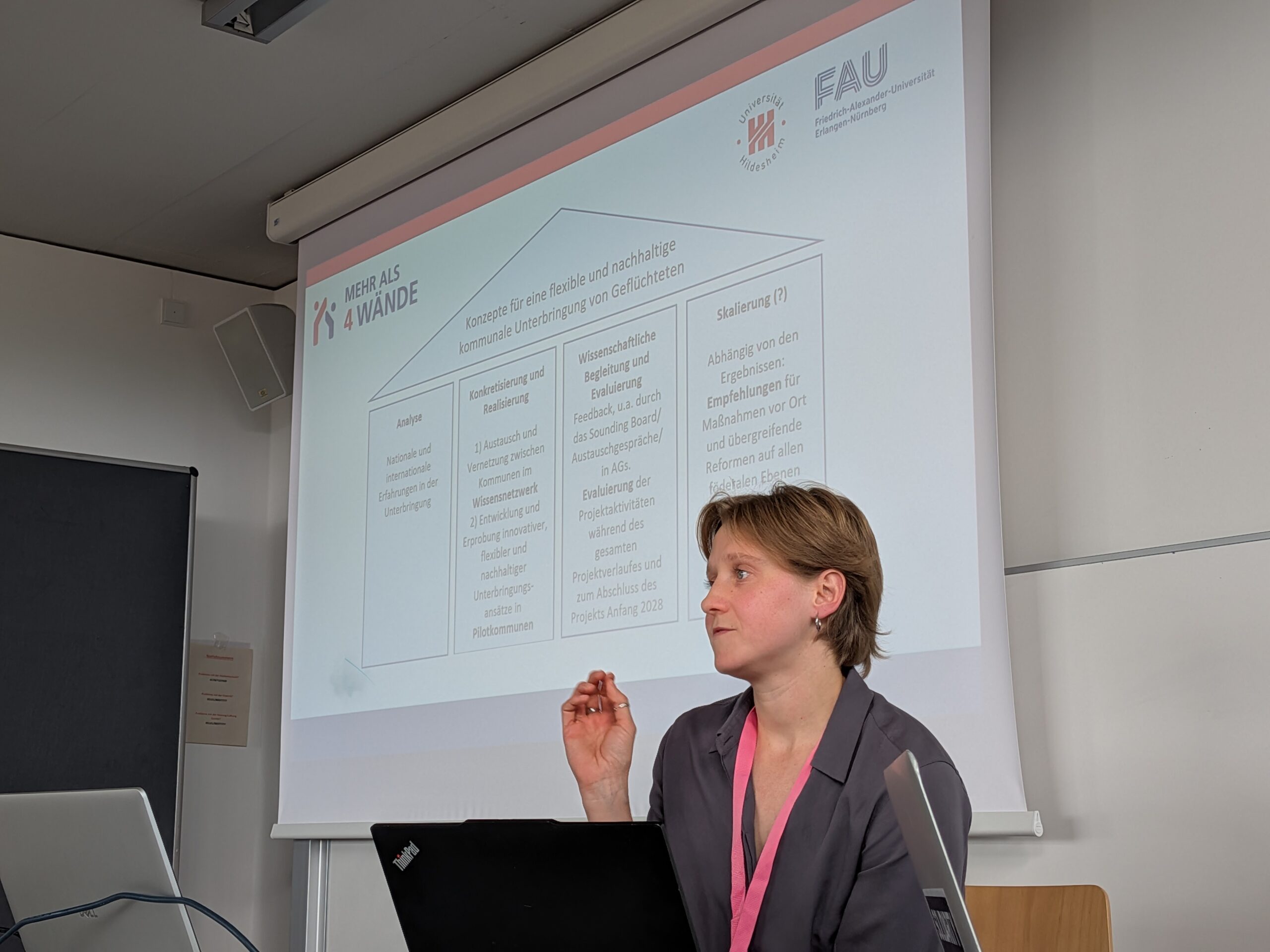
From 28 to 30 September 2026, the ‘More than four walls’ team took part in the conference organised by the German Network for Forced Migration Studies at the University of Hildesheim.
As part of the panel discussion ‘Shaping the Future Despite Scarcity and Restrictions: How Can Local Authorities, Civil Society and Academia Make Use of Local Leeway in Refugee Accommodation?’, Sonja Reinhold presented the approach to value-based and impact-oriented accompanying research used in our project and provided initial insights into the ongoing research. The aim of this research is to evaluate all project activities in terms of achieving the objectives set at the beginning and to monitor the impact of new approaches – on the residents, the local community and the local authority.
During the joint panel discussion, Philipp Piechura (HafenCity University, Hamburg) used a qualitative ethnographic study to demonstrate how ‘hybrid’ accommodation projects – that is, hybrid forms combining typical accommodation with housing – facilitate social integration, and how accommodation facilities can be developed into structures for social participation within neighbourhoods. Corinna Höckesfeld (Tür an Tür – Integrationsprojekte gGmbH) provided practical insights from a civil society perspective on how, through targeted networking, community-based approaches and the collection of examples of good practice, access to housing for refugees can be sustainably improved despite a tight housing market.
The ensuing discussion focused not only on questions regarding the accompanying research but also on aspects of the overall project. Among other things, the discussion addressed how local authorities in eastern Germany could be involved even more closely in the project, what role the sounding board plays as an advisor, and how the project’s ideas and ongoing experiences can be effectively communicated to the wider public. Overall, the panel highlighted that, despite challenging conditions and limited resources, there is scope for local action which can be successfully realised through cooperation between local authorities, civil society and academia.
Photo: Danielle Kasparick
